Showing posts with label beetles. Show all posts

Friday, 3 August 2018

My improved offer for budding coleopterists


Dorcus parallelipipidus (Lesser stag beetle). CC image by Uwe W.
I have just been on a weekend course about beetles, at a Field Studies Council centre in Surrey. Yes, such things exist, and it's marvellous that they do. Imagine entering a room with a dozen other beetle fans and not having to explain yourself; being able to make enthusiastic gasping and squeaking noises about the creatures without restraint. It was great. One day I hope you will appreciate this sort of thing even if you don't now. You meet like-minded people who care about the environment and have a passion for a niche aspect of it: I'm very lucky in my job but a lot of people never experience this day-to-day. The enthusiasm of others inspires you to learn more and more. We were taught and guided by a very knowledgeable (yet very modest) expert - county recorder Steve Bolchover. Unlike when you're working alone, you don't have to sit in a limbo of not knowing if you're doing things and identifying things correctly or not. So that expert support helps you accept and absorb information much faster.

Obviously there's only so much you can take in over a weekend. There are a huge number of species in this country and most are not easy to identify for the beginner. In fact the enormity of the task seemed even more daunting at the end of the course than the beginning, ironically. But I now have more tools in my arsenal to draw on.

By Harde and Severa. It's old and it doesn't look 'serious' but it's the only book with so many illustrations.
I have a couple more strategies to share with you for identifying and displaying your specimens. I have bought a new book (I will never, ever have enough books I suspect - Steve had dozens, many obscure and some in other languages), and I have some other useful identification materials kindly shared by the tutor. I have a new appreciation and enthusiasm for card mounting small specimens, so can help you with that, and new advice about collecting techniques and despatching methods.

A willow flea beetle, one of my tiny finds (c2mm). CC image by Tristram Brelstaff.
 It's been very dry and hot as you know, so there weren't a huge number of beetles that could be easily found: most of the ones I found were tiny. They might have been tiny, but they were still really amazing under the microscope - they can have such superb colours and sculpturing of their bodies. I found and managed to identify the beetle above, Crepidodera aurata. 'Aurata' means 'golden'.

I felt quite chuffed to pick up a Lesser stag beetle (Dorcus parallelipipedus) from under some wood (as the picture at the top) - but this was nothing compared to the female (not Lesser) Stag beetle (Lucanus cervus) that my course-mate found on our trip to a common. It was unmistakable and massive - it's this country's largest beetle (you'll be pleased to hear it was allowed to go on its way undisturbed). So that was an excellent moment and proved that you don't know what you're going to find - but you have to get stuck in and grub about to look.

Wednesday, 29 November 2017

Photograph your specimens through the microscope

I sometimes think of myself as a bit of a Luddite eschewing modern technology (a student laughed at me on a field trip last year for actually using a paper map... I like to think he was sorry when his phone ran out of battery). But when it works I do like it really.

Today I finally got a microscope camera to talk to a computer. I won't bore you with the details because the important thing is that it now works and you can now come and use it. Getting the lighting right seems to be a fine art but I'm getting there. You can zoom in to the important features of your specimens, snap a photo, and then print it out and stick it in your notebook. I used it to identify two freshwater snails and I was very pleased.

They both came from a local pond lined with stone blocks (which apparently used to be where the local gentry washed their carriages - who knows). It didn't look like a very promising environment - it's pretty stagnant with more mud than water! But this actually made it a different sort of habitat to the usual ponds we visit - and so it turned up a species I'd not seen before.

You can see this species is very tightly coiled. It's only about 6mm across, and has 5+ whorls.


But also, it's very thin through - only about 1mm. I managed to hold the shell so you can see its aperture (which is pretty round).


So with these relatively few facts and a look at Collins 'Lakes, Rivers, Streams and Ponds', I identified it as Anisus leucostoma -  the White-lipped ramshorn snail. It doesn't care if the pond it's in dries up a bit: it can resist drought by staying in the mud. There's a similar looking species (Anisus vortex) but it's found in running water (and has an oval aperture) - so can be safely discounted I reckon.

For freshwater and terrestrial species I very much like the drawn illustrations in Janus's 'The Young Specialist Looks at Molluscs' (overlook the daft title) - it shows the shells from different angles (you can get a secondhand copy for about £5, or you're welcome to look at mine). The names can be out of date but that's relatively easily sorted (I might make a list to share).

The other species (in fact the only other thing alive it seemed) was a dextral snail (meaning its aperture is on the right if you hold it upright towards you). You can see the aperture is huge compared to the rest of the shell - it's about 3/4 the height. There's a little dichotomous key to Lymnaea (pond snails) in 'LRSP' - if you follow that (and look at the angle at the top of the aperture) you'll conclude this species is Radix peregra, the romantically-named Wandering snail.


I'm sure with a bit more experience with the lighting (and a bit of fiddling with Photoshop) you could make your photos even clearer. These snails were wet and I probably should have dried them to help with reflections and focusing. But I hope this encourages you that tiny things can be photographed fairly clearly. (You can also have a go down the microscope with your phone, with a steady hand).

Also on the subject of snails, did you know that because their shells are so persistent, they're used by archaeologists and people interested in past climates to work out what environments used to be like? You can see here that freshwater snails have been grouped according to their taste in habitat, so if they're uncovered hundreds of years later you can infer what it must have been like where they were living. My Ramshorn snail is in the (quite rudely titled) 'slum' category. One man's slum is another man's perfectly adequate muddy pond, thankyou. Also, 'catholic' doesn't refer to the snails' religious beliefs, but that they have wide-ranging habitat tastes.

 from Brown (2001) with updated names

So if you're collecting snails - or anything - the moral of the story is to look in a variety of habitats, and then you will find a wider range of species.

Wednesday, 15 November 2017

Your new skills can help make a difference

A lot of moths visiting a trap in Brunei, 1982. CC image Accassidy.
The other afternoon I was listening to Inside Science on Radio 4, and they had a piece about 'moth snowstorms'. That is, people were remembering when they would drive along in the countryside at night, and moths would be flying in from all angles into their headlights, and they'd have to start their windscreen wipers. It's certainly not something I've experienced in my lifetime. In fact it seems quite a mad idea, even though it must have been unremarkable not so long ago. Something that did ring a bell was motorcyclists saying they used to have to stop regularly and clean their visors of squashed flies. I can remember (in the 90s) saying to my dad that my friend's car was covered in gummy dead insects, and him complaining that it must have meant we were driving too fast. Some people suggest cars might be more aerodynamic these days, which might account for why gummy insects don't seem to be a problem. But that doesn't explain the visor thing - there'd still be insects on visors.

My point is, we seem to be losing insects, fast. Data from amateur entomologists' malaise traps suggest a loss of 75% in the last 25 years. I don't need to tell you that sounds pretty terrifying, when insects are a fundamental part of the food chain and pollinate a lot of plants (including our food plants). It was astoundingly refreshing to hear that the alleged environment minster, Michael Gove, has actually come round to the idea that neonicotinoid pesticides need stricter controls. One can only hope it's not shutting the door after the horse has bolted. You'd imagine spraying pesticides all over fields can't have helped matters, in addition to problems caused by other modern farming methods. So perhaps stopping spraying them might help restore some of the invertebrate populations.

A malaise trap. CC image Ceuthophilus. Nothing to do with uneasy-feeling malaise (though that may be for the insects), but actually invented by the Swedish Mr. Malaise in the 1930s.
Whilst this sounds like environmental doom and gloom (which yes, it probably is) - you have chosen this degree course so presumably want to try to make the world a better place. You can be part of the antidote to your own gloom. By developing your identification skills and submitting records to recording schemes and records centres, you can help make some difference. Your data can feed into a big picture which can persuade the powers that be to actually do something. This might not be a straightforward process because it involves politics. But having the scientific evidence has to be of critical importance, surely.

You might think "ah, what difference can I make? :( " But there really aren't that many people out there who have good identification skills. Particularly if you focus on something even slightly obscure. If you chose to go to a local habitat and record what you find, it's possible that nobody would have done that for ten, twenty years (or even ever). You might find something Really Interesting, and conceivably that could help get the site a modicum of protection one day. And even if you don't, it all becomes part of valuable data about today, and can be compared with what happens in future, and if records exist, with what was present in the past. (iRecord is an easy way to submit a record of anything you find, but if you prefer the support of a specialist scheme, the Biological Records Centre has a comprehensive list of contacts.)

Student A's lovely lichen find. CC image Jason Hollinger (California)
The other day, one of the third years popped in to see me. She chose lichens for her collection last year and got really into them. She'd been out lichen-hunting recently. When she got home and looked in her 'Dobson' guide, one of them seemed to be something unusual. The only species that seemed to match was a distinctive orange-grey lichen with little eyelashy spines around the fruiting bodies. But Dobson said it had only been seen in very few areas and was now thought extinct in this country. She had a tiny sample and we both squinted at it down the microscope. Nothing else seemed to match. I said I thought she should speak to David Hill, my esteemed lichen tutor from my course.

It turns out she was right with her identification and he was "super excited". Isn't that amazing! So this is proof that you too can find and report something excellent. She's brought something back from apparent extinction. I guess the poor lichen was never quite extinct in the first place (though it's evidently very rare) - but the point is, how many people are looking at lichens, and how many people have the skill to identify them? Not many. So your developing skills can make an impact. You can be one of an elite group that is knowledgeable and enthusiastic about lichens, beetles, mosses, or whatever it is that grabs you. We can only conserve things when we know they exist. You will be able to contribute to the body of knowledge of what's out there. Be encouraged.

There are links to over 200 recording schemes at the NBN Gateway.


Friday, 3 November 2017

For your Christmas list*: a hand lens

(*Other popular religious and secular present-buying opportunities are available. Or just treat yourself.)

I've just been to Dartmoor with the new first years. Likely you went on this trip yourself and will be able to recall the amazing Wistman's Wood, an eldritch botanical wonderland dripping with lichens and mosses. I think it's one of my favourite places.

CC image by Alex Jane
Students are obliged to spend some time collecting data about un-botanical things like wind speed. But whenever possible I tried to lure them towards close examination of the weird and diverse species covering the trees and boulders. A few people looked like they got seriously hooked, which was very gratifying. And I think the secret to an appreciation of lichens and bryophytes is a simple thing: a hand lens.

I wish I could present one to everybody but it seems university bean-counters are not keen. I can always lend you one (quality and smeariness varies). But ultimately I would urge you to consider getting one yourself. It doesn't have to cost much and it will last you a lifetime. Plus you will always have it to hand if it just lives in your bag. And you won't have any slight squeamishness about holding it right up to your eye after a dozen other people have had it in their clammy hands. Seriously, it will open up a entire microscopic world that you cannot really predict. I'd say it makes Everything more interesting - the unsuspected detail of plants and invertebrates and all sorts. But in the short term it'll certainly make your collecting a more interesting experience and make it easier to identify what you're looking at.

Like I say a million times, 'Hold it right up to your eye'. CC image from the National Park Service.
But what to get? Magnification of x10 is fine for most things. You can get twin versions which have (say) a x10 at one end and a x15 at the other if you're feeling fancy. Another thing to consider is the diameter. My lens is about 15mm across. Larger diameters are recommended.  I thought I was quite happy with mine but now I'm starting to wonder if a larger diameter wouldn't be better - it transmits more light and makes things easier to see.

You do want something that's of good enough quality that it's not going to annoy you with its blurry pointlessness. You don't necessarily have to spend huge amounts though.

This Quicktest page shows you how different lenses vary in quality (which is quite eye-opening) and therefore in price. They have a large range for sale and they make it very clear what you're getting. There are also many other reliable places, like the local company Brunel Microscopes, or UKGE, or entomological suppliers like Watkins and Doncaster,

 This is the one I have at the moment, from Quicktest, which is about £30 with delivery. It has a slightly larger size than most, so lets in a bit more light, and seems super clear - I'm really pleased with it. But you don't have to go that mad - something about £15 can be pretty decent, judging by the advice linked to above. Cheaper ones are a good way in but they're necessarily blurrier and more likely to fall apart. I bought a load of half-decent ones for work last year, but they're extremely pocketable and disappear constantly. This is disappointing and makes me loathe to spend as much again - but then spending less is a false economy if the lenses are rubbish. So if you're even half keen it's a good reason to get your own and look after it - it should last a lifetime if you don't lose it!

I'd also recommend getting a lovely bright lanyard to attach to it. Then it's much easier to find if you put it down somewhere or it falls into the vegetation. There's a huge selection on Ebay, for example. If you wear your lens round your neck you will recognise and be recognised by other natural history buffs, like some sort of weird masonic tie / handshake. This is not necessarily a bad thing: you might meet someone knowledgeable and interesting. Nerdy, probably. But nerdy about something interesting.

Public domain image by Bill Gillette - girl on a fieldtrip in the Rockies, 1972
A useful thought I read recently - when you're using it, think of it as a keyhole. That is, you must put your eye right up to it to see through. Either bring the object you're looking at towards your eye, or (often more undignified but unavoidable) bring yourself close to the object. The latter is why you might see lichen enthusiasts sprawled across the landscape, bums in air, apparently pressing their faces against the rocks.

And finally, it's possible to integrate this low-tech highly-useful bit of equipment with modern technology: with a bit of practice you can take photos through it with your mobile phone. And those would be perfect stuck in your notebook.

(P.s. - What's more, a lens will repay you handsomely on the field trip to Tenerife, where there are many fascinating plants with strange adaptations to examine microscopically. I much recommend getting one in readiness for that).

Thursday, 2 November 2017

Beetle bait

Look at me, sitting here typing on my lunch break. You see the problem is all this stuff is too interesting. I could be jogging round the campus or reading the news or gossiping or something. But those things pale compared to excavating interesting plant / animal information from the internet. This is today's random find. It's from the Journal of Entomology and Natural History and is an idea for making pitfall traps for beetles.

Oh yes you may have done pitfall trapping before. But have you baited the traps with disgusting yet irresistible beetle-bait? I think not.
gravity-defying illustration from the article
The idea is that you put the stinky delicious things in a bottle, and you hang it above your ground-buried traps. That way the smell lures in creatures, but the traps are not contaminated by decaying goo. That way you don't have to scrape decaying goo off your specimens. If you even had any specimens left after larger creatures were drawn in by the smell and ate them. So this seems like a better idea. Have a look at the article for more detail.

The author, C R Turner, tried two recipes. One was made from melon, apple and banana left with sugar and baker's yeast in a sealed container for a week. Mmmm. That was apparently successful in attracting (amongst others):
Dorcus parallelipepedus (L.) - Lesser stag beetle
Carabus violaceus L. - Violet ground beetle
Carabus intricatus L. - Blue ground beetle
Serica brunnea (L.) - Brown chafer
and Trypodendron domesticum (L.) - Ambrosia beetle

The other was even more stinky, consisting of fish heads and chopped bones. But the beetles loved it and it pulled in:
Nicrophorus humator F. - Burying beetle
Nicrophorus vespilloides Herbst. - another Burying beetle
Thanatophilus rugosus LL. - another Burying beetle
Omosita depressa L., - another one
Geotrupes stercorosus (Scriba), - Earth boring dung beetle
Margarinotus cadaverinus (Hoffm.) - A clown beetle
and various others.

Pitfall traps are likely to catch beetles that have a quite active wandering-around lifestyle. But you can see how different bait attracted a different range of species. Some of them were really rather unusual, to the point where you might want to let them go, not despatch them. But it would be very good to know that you'd found them and where. Your local beetle recorder would be very interested.

To return to my previous typing about etymology, it's also rather interesting to see all the death-related words in the scientific names of the second group.

If you want to try pitfall trapping it's worth bearing in mind that the article suggests using ethylene glycol. But that's poisonous to birds and mammals and doubtless frogs and newts. And you wouldn't want to kill any of those. So you could just try using a little bit of water with a tiny bit of washing up liquid (the latter to break the surface tension). That'll probably be sufficient to capture and kill the beetles, and if you check the pitfall traps often, you can hoik out your specimens and put them in a pot with some invertebrate preservative. Or as you'll probably want to pin them, you might not want them wet in the first place. So it's not a bad option to avoid the liquid altogether, and just check the traps daily to pick out what you've caught (but they may eat each other first. If they haven't eaten each other, you can free any creatures you're not interested in). You could pop in a bit of leaf litter for somewhere to hide. And for a fancier trap you can have a grid over the top that stops large things getting in. There are many options. But whatever you choose, remember to collect all the cups at the end of your trapping, so they don't kill things indefinitely in a decidedly anti-conservation fashion. I'll let you decide what to do with your stinky trap bait.

The rather lovely Nicrophorus vespilloides. CC image Evanherk.
 Nicrophorus beetles are interesting despite their unsavory corpse-eating behaviour - they are a rare example of insects that show parental care. You can read all about it (along with humorous illustration) on Wikipedia (although once your interest is piqued there seem to be quite a few research papers discussing it).

Friday, 6 October 2017

For aspiring coleopterists

From Janson's British Beetles

After the frustrations of yesterdays spiders I found myself longing for the soothing world of beetles. A beetle on a pin is much easier to spin round to different angles for close inspection, than a spider lounging in a dish of alcohol.

As with a few of the other collection options, you might wish that you'd been able to get out in the summer to find beetles. But although many species are most active then, you'll also be able to find specimens over the winter and into the early spring. Instead of looking on flowers, you'll have to think of other habitats.

Darwin, as I mentioned before, was a keen beetle fan. Here you can read that he was always searching for new collecting methods. He wrote:

"I was very successful in collecting and inventing two new methods; I employed a labourer to scrape during the winter, moss off old trees and place it in a large bag, and likewise to collect the rubbish at the bottom of the barges in which reeds are brought from the fens, and thus I got some very rare species."

 You might not have your own labourer to help you, but you could certainly try shaking moss over a tray. I fear fen barges with reeds might be a thing of the past, but any pile of vegetation should be worth a look.  Similarly vintage advice suggests

"In the winter, very many beetles can be obtained by cutting isolated tufts of grass, pulling moss, etc., and shaking them over brown paper; the proceeds need not be examined on the spot, but can be taken home in a bag and carefully investigated indoors at leisure. In this way, by a judicious selection of likely-looking spots, a few hours' work out of doors will often furnish occupation for several evenings.

In the autumn, examining fungi and puff-balls, and sweeping among dead leaves under trees are very productive; and later still, the leaves (especially the black, damp, bottom layers) may be sifted or shaken over the brown paper with great results. 

Lycoperdina bovistae is found in association with Lycoperdon puffballs. ('Lycoperdon' means wolf fart. It really does).  PD image.

 On the sea-shore, heaps of decaying seaweed harbour many species, and dead fish or birds become capital traps; but a "keeper's tree" in a wood, with dead vermin nailed to it, is the luckiest thing to find.

Many species come to the running sap of the stumps of felled trees, and a great number haunt the wet burrows of the Goat Moth in the solid wood, whilst ants' nests, both in woods, tree trunks, and sandy places, produce an enormous number both of specimens and species, many of them being very rare.

Tapping rotten twigs and sticks, and shaking the damp bottom layers of grass and rubbish heaps and hay-stacks, will produce many species in profusion."

Naturally I am not suggesting that you go out and decimate the landscape and destroy all its trees, fungi and ants nests. And you might not feel like poking about in decaying animals. But the options are there (given you have permission to collect from the owner of the land and you're not taking something protected, natch). A couple of years ago a student submitted an excellent beetle collection, many specimens of which had come from dead wood. If you can look in different habitats you will find different species, so be hopeful and imaginative.

Interesting shape 'galleries' eaten by a larval Scolytinae beetle. CC Bernard Dupont

Friday, 28 July 2017

2016/17 collections: moths and beetles

Below is an excellent moth collection from one of last year's students - it was given 80%. Unfortunately my photo isn't so excellent (and as such collections tend to be proudly taken home, it's the only one I have to show you now). You can see that the moths have been pinned and spread in approved traditional fashion. This is a difficult thing to do, and evidently appreciated by the markers ('professional standard!'). They also gave good marks for the neat and informative labels (although they noted that habitat would have been a good addition).


It's good to remember that part of this very high mark came from the effort the collector put into his field diary and monograph. Some of the feedback for the former read: 'very neat and informative... excellent diagrams ... includes processes and methods... should record observations as they occur... should make clear which species caught during which trapping session...' 


Above is a page from the field notebook. I'd say that the idea of making a table with standard headings will help you to record everything neatly, and remember everything every time. But even if you don't go down that route, you need to record information about times and dates, numbers of different species caught, your sampling strategy, the habitat, and so on.

Some possibly useful feedback for the monograph warned against citing too many internet sources, and stressed that you should use the normal citation format you'd use in your essays.


Below is the best beetle collection from last year, earning a mid-80s percentage.


The labels aren't so traditional but they're certainly clear, and the additional label at the back emphasises how specimens have been positioned (that is, in family groups). The good number and variety of specimens is recognised in the marking, along with their healthy state of preservation (no squashed or legless beetles here).


Again, the overall high mark was supported by effort in the monograph and field diary. The former sounds tricky to master, needing to be both wide ranging and concise (which is why you might not want to leave it until the last minute). The latter was praised for its well-organised content, good level of detail, and (take note) its annotated photos. And I'm not saying that you should judge a book by its cover, but its author has created an attractive notebook which was engaging to look through and read. And that can't be a bad thing.

Yes, it can be a frustrating fiddly process to learn the practical and identification skills these students developed. But I think their collections show that you'll certainly get out what you put in, if you choose these groups.

Friday, 3 February 2017

More beetle resources

Haliplus lineatocollis, a relation of my find. CC image Wolfram Sondermann.
Last term I was trying to assist a very determined student in his identification of beetles for his 3rd year project. He worked very hard - they require a lot of concentration :) We were using Mike's Insect Keys, various books, the Watford Coleoptera Group, the superb guides by John Walters (scroll down for the list) and other things on Mark Telfer's site.  I've also recently noticed this guide to weevils by Mark Gurney.

The WCG is usually good for a detailed photo, but they don't have everything (admittedly we're not in Watford). But we found an alternative place to look once you've got a suspect, called Kafer der Welt (German for 'Beetles of the World'), and you can separate the species found in the UK to make a search easier. There's also The Coleopterist website which has many photos if you go to the gallery (though you do have to know the name, it's not like scanning through the thumbnails at the WCG).

For a practical this week I had to collect some creatures from the ponds. There were several species of beetle zipping about in the bucket - I had a close look at them under the dissecting microscope while they struggled ineffectually in a droplet of water. I'd been led to believe that water beetles are particularly difficult to identify, but using L.E. Friday's key (which is now downloadable from the FSC website), I managed to get two species and a good way towards another. The key's been updated now I see. I've also spotted a guide to the relatively huge Dytiscidae diving beetles on the Suffolk Naturalists' Society website (where there's also one for aquatic bugs) .

I particularly enjoyed seeing the long swimming hairs on the legs of one beetle (Haliplus confinis), and it had a interesting translucent plate covering the top of its back legs - for keeping safe a bubble of air for diving down. Also it had beautiful golden elytra (wing covers) with black lines of tiny holes. Very nice for something no more than 3mm long. I love how the microscope opens up a new world of interesting things.

The only thing is that they're very tiny so if you did put them in your collection you'd need to glue them on the tip of a tiny triangle of card, and then pin through the card. Aka "Pointing." It's a bit fiddly. But lots of coleopterists relish that sort of thing for some reason.


Friday, 11 March 2016

Successes in beetle identification

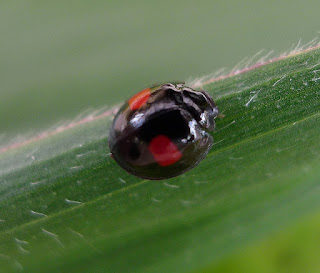
Kidney spot ladybird, as seen in OJ16 this week. It's a beetle too. CC image by GailHampshire.

Yesterday afternoon, student B and I had a go at identifying some of her beetles. It really was a triumphant success and she kindly said she felt a lot more confident about the process. I had a very pleasant afternoon and I think we both felt the geeky satisfaction of tracking a specimen through the keys and coming out at the right answer.

However, I thought I would mention here that this was not a speedy process. I've done some beetle i.d. before and so I was able to explain the terminology as it came up, pointing out the different parts of the beetle's body and showing her the classic beetle dichotomy of Crossed vs. Uncrossed Epipleura. So this speeded things up for her. But in three hours we identified three specimens. Yes this included faffing about finding microscopes, pins, printing off keys and chatting about other things. But you should still be aware that (at least to begin with) identifying your beetle (or spider for that matter) is going to take time. Do not leave things until the last minute.

Besides, we were enjoying the process, looking at the amazing detail of the beetles down the microscopes - they were surprisingly hairy, or stripey-lined, or with massive jaws, or with crazy antennae. So it was a pleasure to spend the time looking at them. Please do come and use the microscopes to examine your species, and I am only too happy to go through the identification with you. It's really useful to have two pairs of eyes to judge some of the characteristics.

We started off each time with Unwin's guide to families:


B's first specimen was huge, so much so that we initially tried to convince ourselves that the key was taking us towards the elbow-antennaed Lucanidae (stag beetles). But reason and logic prevailed. The short elytra (wing covers) led us to the Silphidae (burying beetles).

The extremely philanthropic Mike Hackston has an illustrated key to the Silphidae. And once we had got down to the right genus, his key for Nicrophorus led us to the answer: Nicrophorus humator. Fair enough, with a common species like this one, you might have been able to pick it out of the photos in a general insect guide. But you wouldn't have gleaned useful beetle-observing skills along the way and you might not have looked closely enough at the details that distinguish it from similar species.

CC image by Laisverobotams.
You'll see this species (the Black Sexton Beetle) has short elytra that don't cover the tip of its abdomen, and they look as though they've been cut off, straight across. It's got rather distinctive clubbed antennae too, and they're orange in contrast to the rest of its black body. We were rather taken by the furriness of the beetle's underside. This wasn't mentioned in the keys but we were wondering if it had something to do with the creature's lifestyle. This isn't a sweet little beetle with genteel habits. It's called a 'sexton' beetle because these seek out dead animals and bury them, laying eggs on the corpse. Some species eat fly larvae - and B found this example in a fly trap.

Our next specimen also had short elytra, showing even more abdomen. But its antennae were quite different. We used Unwin's key to put it in the Staphilinidae family - this contains about a quarter of British beetles! but luckily this species is very distinctive and we felt justified deferring to this excellent Watford Coleoptera Group page confirming its size makes it impossible to be anything other than the Devil's Coach Horse (Ocypus olens). It does seem beetles get all the best names.

The Devil's Horse Coach gets uppity. CC image by Galway Girl.

Finally we chose another black beetle from B's collection. It had long thready antennae, elytra that covered its whole abdomen, 'trochanters' underneath, and five tarsi on its front, middle and back legs. This made it a ground beetle - within the family Carabidae. Once again the keys generously provided by Mike Hackston were invaluable.  By steadily working through questions about the shape of its various parts, counting stripes and squinting for the existence of tiny hairs, we were at last able to confidently name it Pterostichus niger.

CC image by AfroBrazilian.
To the untrained eye little black ground beetles are pretty indistinguishable from each other. There simply isn't enough detail in a general insect spotting guide to be sure you've matched a species correctly - with beetles you have to be brave and attack the keys. But (as we did) you might find you enjoy it. You might get a little buzz out of solving the puzzle. And each time you do it, you'll get more familiar with the features you'll be looking for.

Naturally we recorded all we were looking at as we went along, drawing little sketches and writing down the reference numbers of the keys. Not only will this get you some marks for your notebook, it'll be a good reminder of all your previous beetles' features when you come to your next specimen.

A little note: you're welcome to come in whenever the university's open and sit in our lab. But just to say, I'm away on an exotic field trip for two weeks and will be back after Easter. I know. It's a hard job. And then you have three weeks to finish your collections. Let me know if you'd like my assistance and when.

Monday, 9 November 2015

Never be without a pot (id-ing your dung beetle)

This morning I was crossing the forecourt of a petrol station when I spotted a huge fat (slightly squashed) beetle. It was too early to be embarrassed in front of normal people, so I scooped it up and popped it in the plastic pot in my bag. Never be embarrassed and never be without your plastic pot, that's my advice.


This would not be an ideal specimen for your collection (squashed with 5 legs only) but I thought it would show how I identified it.

You can tell (I hope) that it's a beetle, with its shiny wing covers (elytra) meeting neatly along its back. It has very distinctive antennae - they've got clubbed ends, which when you look down a microscope at them, prove to be made up of various layers.

Something like this, but mine has fewer plates. CC image by Kurt Kulac.
This tells you straight away that you're dealing with the superfamily Scarabaeoidea. This'll come out quickly in the key in 'Collins Insects' (first question - is it a ground beetle with 'rigid hind coxae' (the base of the legs)? no... second question - is it a weevil with elbowed antennae and snouty face? no... third question - does it have antennae with segments that form a 'lamellate club'? YES.

Then you can move to the Scarabaeoidea key. Again it's quite straightforward - are the antennae elbowed? (no - it's not in with the stag beetles). Are the elytra roughly sculptured (something like this)? (no, so it's not in the Trogidae). Are the jaws visible from above, and the antennae 11-segmented? It would seem yes, and that we are dealing with a member of the Geotrupidae - Dor or Dung Beetles. There are only eight of these in Britain, so I felt I ought to be able to get it to species level.

When I put the beetle under the microscope, it was amazing and revolting because complete panic was going on - mites were running about all over the corpse and tiny wormy creatures were waving like mad from every point (nematodes I imagine). Dung beetles are renowned for having mites and their only hope for survival is to catch a lift on another dung beetle. Tough luck this time you parasites. I feel a bit itchy having looked but I think that's psychosomatic, I don't think they're interested in me.

My next stop was the dung beetle key from the Royal Entomological Society. In their family key it mentions a strange feature that confirms it's in the Geotrupidae: the fact that the eyes are divided into two by a 'canthus'. But it seems the purpose of this is as yet unclear.

The remainder of the key is full of beetle-jargon, so I'll spare you and just show you my notes:


I found the RES key difficult to use right at the end so supplemented it with Mike Hackston's illustrated key, and I think I can reasonably confidently conclude I've got Geotrupes spiniger. 

A bit of internet searching also suggested Volume 2:2 of 'Beetle News' for some compare-and-contrast photos and descriptions to distinguish between G. spiniger and G. stercorarius - the jaws of spiniger have a lobey shape (which agrees with my own specimen).

Please do bring in your beetles and have a go at identifying them. If you get stuck perhaps we can crack it together - there's plenty of reliable beetle-related information on the internet which can help.

Thursday, 29 October 2015

Collecting invertebrates - some more reassurance

Volucella zonaria. CC image by Martin Cooper.
Last night at home we were looking at some photos, and one of them was of the strange creature above. It was in August and we'd found it sunning itself on a trellis. At first sight it looked like a massive wasp or hornet, but closer inspection proved it had two wings (not four) and no thin waspy waist - it was actually a type of fly.

I've got an excellent book on hoverflies (these wasp mimics are often hoverflies, i.e. in the Syrphidae family) - it's by Stuart Ball and Roger Morris and called 'Britain's Hoverflies'. And because this animal is so distinctive I was able to identify it with the time-honoured practice of page-flicking. But the book is excellent and the keys are easy to use - you'd probably not have too much problem with less obvious species. However, hoverfly season's doubtless pretty much over, so maybe save your money for next year.

However, I read some very useful advice which applies to other invertebrates too. It's reassuring if you're experiencing squeamishness about killing specimens for your collection. If you take what you're doing seriously, your collecting can be for the greater good.

Ball and Morris say: "Many naturalists frown upon the collection of specimens. The prevailing ethos is 'leave nothing but footprints, take nothing but photographs.' [But] this approach does not work for a large proportion of Diptera, or indeed for many other invertebrates. It is often necessary to examine a dead specimen rather closely in order to ensure an accurate identification.

"So is there a potential conflict between collection and conservation? The authors of the book have both spent most of their working lives employed by conservation organisations and do not consider there to be a conflict. Whilst we recognise that a few rare species have such restricted breeding sites that collecting could be damaging, we believe that insect faunas are at far greater risk through not knowing which sites are important and how they should be managed.

"The collection of a few voucher specimens is extremely unlikely to be damaging to hoverfly populations and, in our view, responsible collecting that adds to our knowledge of the distribution and biology of hoverflies, should be encouraged. However, we would stress that if an animal has died to generate an identification then use should be made of the resulting record! It should be lodged with the Recording Scheme and subsequently made available to conservation organisations and researchers. Although not a good reason to condone collecting, it is worth bearing in mind that you will kill many more hoverflies on the front of your car driving to and from a site than you are ever likely to collect."

Another use for dead flies. CC image by James F Carter

At the risk of quoting half their book, they also offer these thoughts on 'Why keep a collection?"

"Vouchers: You can prove to yourself and others that you got the identification correct. This is especially important when you are starting off. The best way to learn is to try naming some specimens and then to get them checked by an expert. Nevertheless, however expert you may become, it remains important to keep vouchers for difficult and uncertain identifications.

Comparison: The identification process often involves comparative judgements (e.g. bigger than...; eye hairs darker than...). In these cases, it is very useful to have material you have previously identified to hand so that you can remind yourself what the various options look like."

They also link to an updated version of the Code of Conduct for Collecting Insects and Other Invertebrates (2002).

You might also like the discussion on why collecting specimens is still relevant and useful (and will remain so) here on ResearchGate.

Friday, 25 September 2015

General thoughts on collecting


Finnish entomologist Johan Sahlberg and his botanist wife Mimmi, just before they left on their honeymoon field-trip in 1873. Photograph by Antero Saalas.

 The Legal bit: Technically, you should only collect where you've been given permission by the landowner. Realistically, if you collect a sprig of grass from a roadside, no-one is likely to demand you are thrown in jail. But bear it in mind that under the Wildlife and Countryside Act, it is illegal to uproot any wild plant without permission from the landowner. 'Plant' includes algae, lichens, mosses, fungi and vascular plants. You don't need to uproot anything of course, just take parts of it. If you haven't got permission to be on someone land, you shoud confine yourself to public land and footpaths, or else you could get in trouble for trespassing, and that's before you've picked a thing. It doesn't hurt to be following the Countryside Code in general.

It is quite complicated in law, because there's no single law that covers such things. You do have some rights as a 'forager' which have built up around collecting plants for food. The British Mycological Society have some sensible advice regarding picking fungi but you'll find there's increasing worries about people collecting large amounts of mushrooms and then selling them to fancy restaurants (selling things on is not really in the spirit of traditional foraging).

Also, it is very tempting to want to go to a nature reserve to collect - after all, that's surely where all the nature is? Actually, you'll find you can collect a remarkable number of species from uncontroversial places. If you really do want to collect at a nature reserve, you should ask first. In my experience they may give permission - just contact the relevant Wildlife Trust (etc.) and explain you are doing a taxonomic collection for university and only want a specimen or two of common species. Reassure them that you will not be digging anything up, least of all their rare species. Always take the minimum amount of material necessary wherever you are.  

 There's more advice in the Wildflower Society code of conduct. You might also want to read the Botanical Society of Britain and Ireland's code of conduct. It encouragingly says "Collecting small amounts of plant material for identification purposes, for private herbaria, for research or as voucher specimens is usually acceptable, except in the case of protected or Red List species. Indeed, collecting is often necessary if botanical expertise is to be developed."

 The Amateur Entomologists Society has similar advice concerning invertebrates. Although I feel pangs of guilt killing them, the main threat to species in this country is habitat loss. The code points out that "collecting should always be limited to the minimum necessary for the purpose intended, as well as by full compliance with legal requirements relating to particular sites and species."   

It is rather unlikely you'll come across rare species (the clue being in the name). Surprisingly, very few are specifically protected by law. Obviously, if you're in a reserve where one exists, you should make yourself aware of its appearance and avoid collecting any.

In short, use common sense and all will be well. Stick to public places and no-one will threaten you with a shotgun. Develop a casual demeanour and learn to shrug off the strange looks the public will doubtless throw you. Never be without a plastic bag or collecting pot. The latter is the best bit of advice I can give you :)

 
The Health and Safety bit: 

If you look at the course guidance on Blackboard, you will see that before going out collecting it requires you to send a risk assessment to Katy. This is not so onerous, as there is a generic version on Blackboard - you just need to go through it and remove anything irrelevant to your own situation, and perhaps add in anything extra. 

For example, you can delete any of the chemicals you won't be using for preservation. You've survived this long so presumably you are good at common sense - but here's a recap anyway-

Take someone with you (it's more fun, besides).
 Let someone know where you're going and when you ought to be back (a map and a phone are useful too).
Especially if you're like me, take a snack and something to drink so you don't pass out in a ditch.
Take your medicine with you if you suffer from some life-threatening illness (now I feel like I'm talking to my mother).
Take some sensible clothing and footwear with you (and now I am turning into my mother).

Fill in your details on the form - send a copy to Katy and keep a copy for yourself.
Then you can go forth and start collecting.