Showing posts with label monograph. Show all posts

Monday, 31 July 2017

2016/17 collections: seaweed and marine molluscs

I was impressed by this marine shell collection which was submitted as a resit. It's beautifully presented and labelled. It comprises a wide range of correctly identified specimens, and they're carefully displayed so the distinguishing features of the shells can be seen (the spotted cowrie with its little mirror is ingenious). It was given a mark of 77%.


The labelling is clear and includes the type of habitat in which the shells were found - which is useful in addition to the location and grid reference.


The collection includes a rare example of a field notebook actually written in the field. At least, that's what it looks like, with its wind-blown looking notes in pencil. Yes it looks rough and ready, but something of this nature is what the markers will want to see in addition to all those detailed descriptions, annotated diagrams and maps and so on.

Marine molluscs didn't seem to be a popular choice this year, and nor did seaweed. But this is a good example from the seaweed collections that were submitted (I'm afraid my photo is not so good):


You can see where the student has floated her specimens onto pieces of card and then used a photo album to protect them. She collected 15 examples, which were well distributed across the brown, red and green species. Seaweeds can be difficult to identify so larger samples are good as they may be more likely to show well-developed diagnostic features. The labels were praised for their content but the feedback stated they 'would be better if typed' - so if you can pick up a mark or two for simply typing your labels, it definitely seems worth the effort of doing so. This collection was given a commendable 66%, but an extra mark here or there might have been gratefully received. The monograph was given excellent marks (12/15) for being well researched and presented, 'with good reference to your own collection' - another thing worth taking on board.


Here's a picture of the corresponding notebook. I liked the hand-drawn map with personal observation of the habitat (something you won't get with the OS), plus the use of a scale on the photo.


2016/17 collections: trees in winter

The 'Trees In Winter' category produced the largest number of collections this year, as is often the case. But the marks vary hugely. To do well you have to spend time finding a wide range of species, taking good quality specimens, and preserving, presenting and labelling them neatly.  Plus recording your efforts in your notebook on identification, habitat and so on. That is - as for any other collection. It's not about going out and grabbing a bunch of twigs - it's not the best choice for a last minute collection, although it's something people do try.

But let us emulate these super collections, which were all given Firsts.


This shows something I feel bad I haven't really pushed before, and that is to include samples of bark, fruits, seeds and catkins - things other than twigs that help you identify the tree. But note that they have to be things that are present over winter. There's nothing that upsets a marker so much as seeing twigs that have already burst their buds.  This student has put two species on one page - they are from the same family, which allows for comparisons. Having said that, this was frowned on by the marker of another collection, so you'll have to make your own choice. You'll notice that the bark sample has been labelled separately (if you submitted catkins or fruits, I think they'd expect the same). This collection had 19 species and did well across all sections of the mark scheme, gaining 75%.


The markers like the specimens to be easily scrutinised, which means that mounting your twigs separately (rather than on a big board altogether) often wins marks. You can see how the twig above fills the space of the card well. It's nice and flat (it might have been pressed, or more than likely selected for its shape) and it's attached to the stiff supporting card in an attractive but secure fashion. It is large enough that it includes the important features that are diagnostic for its identification. The label is neat, it's typed, it includes lots of useful information. Plus, I imagine each label is in the same place on each card. It's no wonder this collection was praised for its professional presentation. Incidentally, it comprised 23 trees and 3 shrubs.


Collections of winter twigs can be quite bulky and the student above chose boxes to keep everything in order: this went down very well with the person who marked it. They were praised for the clarity of the display of their 19 specimens, and were given a first.

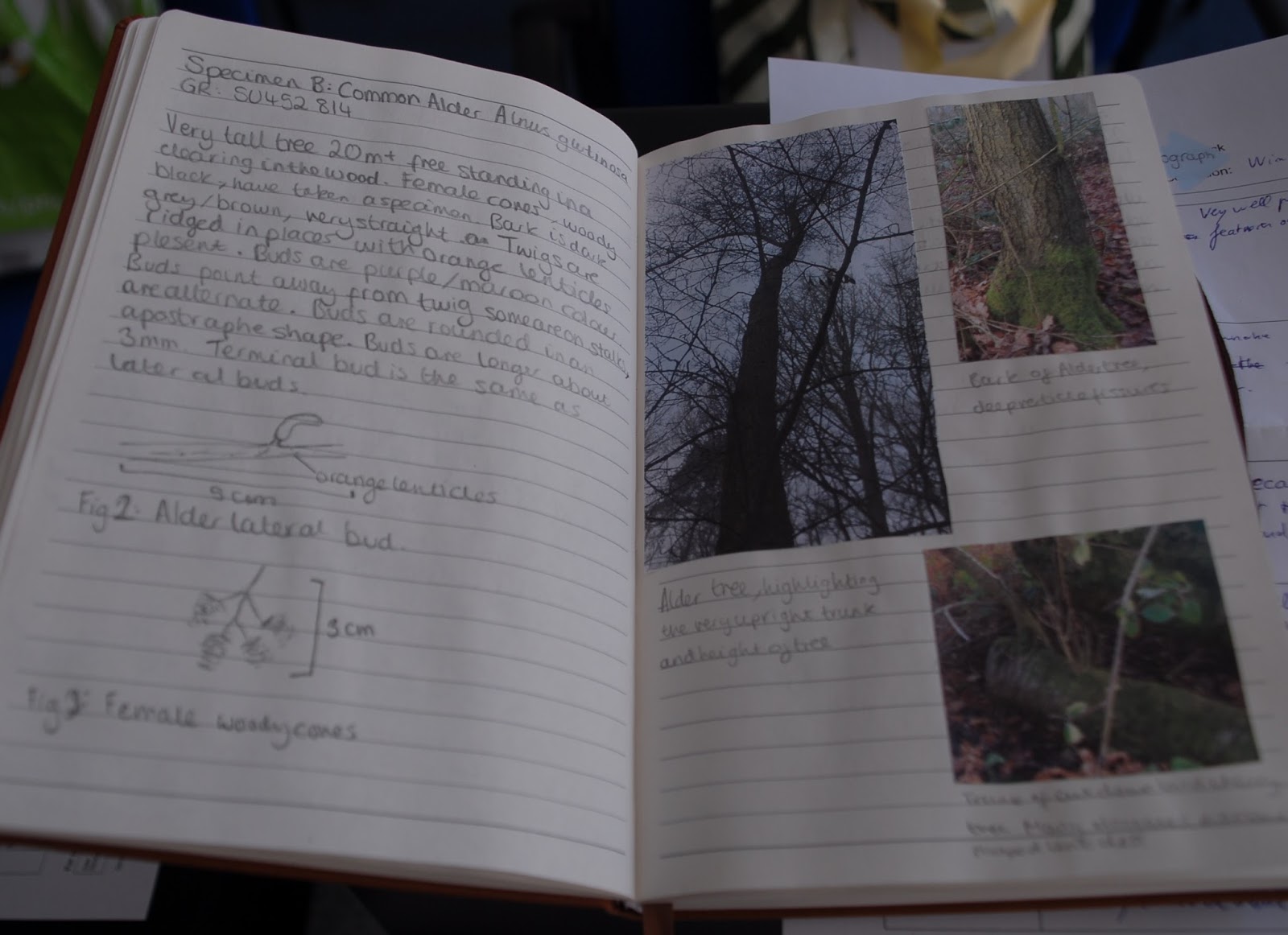
The following field book belongs to the middle collection above. It's excellent - it looks readable and inviting, and includes descriptions of the sites visited, details about the trees in situ, labelled diagrams with a scale, photos and maps (plus, one would imagine somewhere, proof of use of a key). You can see why the student was given a mark in the high 70s. 


On the right-hand page the student's highlighted some features of the tree's bark and overall shape.


 On these pages you can see a clear map of the site, plus their thought processes in trying to describe and identify the species.


This page is also interesting as it mentions the coppicing management of one of the sample sites. Plus, a few annotated colour photos are never going to detract from how a reader perceives your notebook...

Remember that the monograph has to be written succinctly, so it covers the whole taxonomic group that you've chosen, but also refers to the significance of the specimens you've collected within that.

Friday, 28 July 2017

2016/17 collections: mosses and liverworts

It pleases me to tell you that record numbers of people chose to collect bryophytes last year. By record numbers, I mean five. But I think mosses and liverworts are lovely, and it was very nice to spend time with fellow appreciators. What's more, the students all got good marks (two high 2:1s and three firsts).


You may not think envelopes in a box is a particularly inspiring display, but it's traditional, easy to label and put in family order, keeps everything in its place and stops things going mouldy. Plus, it gets good marks. This one was in the mid 70s. Its standardised labels (albeit untyped) containing lots of information were praised. The student also gained marks for the number of specimens collected, the 'excellent identification' and the effort that had been made in finding species from a range of families and habitats / locations.

Here's a page from the same student's field diary, which was said to include 'good detail.. good use of maps and sketches...'.


The feedback for the moss monographs highlight something that can be applied to any group - that amongst general information there should be some reference (with technical details) to the range of specimens that you yourself have collected.

Don't be thinking that mosses will automatically get a good mark - they require concerted effort. But if you're willing to put some effort in, at least they're relatively easy to find and transport. They're good for people that like something fiddly but haven't the finesse not to break off beetle legs and moth antennae (I'm talking about myself here).

2016/17 collections: moths and beetles

Below is an excellent moth collection from one of last year's students - it was given 80%. Unfortunately my photo isn't so excellent (and as such collections tend to be proudly taken home, it's the only one I have to show you now). You can see that the moths have been pinned and spread in approved traditional fashion. This is a difficult thing to do, and evidently appreciated by the markers ('professional standard!'). They also gave good marks for the neat and informative labels (although they noted that habitat would have been a good addition).


It's good to remember that part of this very high mark came from the effort the collector put into his field diary and monograph. Some of the feedback for the former read: 'very neat and informative... excellent diagrams ... includes processes and methods... should record observations as they occur... should make clear which species caught during which trapping session...' 


Above is a page from the field notebook. I'd say that the idea of making a table with standard headings will help you to record everything neatly, and remember everything every time. But even if you don't go down that route, you need to record information about times and dates, numbers of different species caught, your sampling strategy, the habitat, and so on.

Some possibly useful feedback for the monograph warned against citing too many internet sources, and stressed that you should use the normal citation format you'd use in your essays.


Below is the best beetle collection from last year, earning a mid-80s percentage.


The labels aren't so traditional but they're certainly clear, and the additional label at the back emphasises how specimens have been positioned (that is, in family groups). The good number and variety of specimens is recognised in the marking, along with their healthy state of preservation (no squashed or legless beetles here).


Again, the overall high mark was supported by effort in the monograph and field diary. The former sounds tricky to master, needing to be both wide ranging and concise (which is why you might not want to leave it until the last minute). The latter was praised for its well-organised content, good level of detail, and (take note) its annotated photos. And I'm not saying that you should judge a book by its cover, but its author has created an attractive notebook which was engaging to look through and read. And that can't be a bad thing.

Yes, it can be a frustrating fiddly process to learn the practical and identification skills these students developed. But I think their collections show that you'll certainly get out what you put in, if you choose these groups.

Tuesday, 23 June 2015

Guidance on the monograph

CC image by Nic McPhee
This part of the assignment requires you to be succinct: you've got to squash everything you want to say into 500 words, so there's no room for waffling. You have to give a list of references too (not included in the 500 words, fortunately) so do try to pick sources that sound authoritive and not just some dodgy page off the internet, unless it's something like the British Bryological Society's website. It may not hurt to put in the details of the undoubtedly reputable keys you were using to make your identifications.

As you're presenting a taxonomic collection, the most important thing to focus on is some taxonomic information. The Guidance suggests - how many families / species are in your group in the UK, and how many are in your collection? What are the key diagnostic features of your group / each family represented? Are there any rare / interesting specimens in your collection?

The Guidance also suggests you can make remarks about the ecology or human uses of your group, but not to make that the main focus of what you write. So I guess this includes interesting things like: the habitats where they're found; the variations of their 'form and function'; any economic, social or cultural importance; any particular existential threats they face.


Most people seem to leave this part of the assessment until last - and perhaps that's very sensible, as by then you are more familiar with your group. But you probably don't want to leave it until the extreme last minute as it's actually quite difficult to be succinct, and you'll probably have to spend some time editing and moving around your thoughts to make them readable. Ultimately it's a daft thing not to spend some time on this because 500 words isn't a big deal, but it can earn you up to 15 relatively easy marks. That's 15% and the difference between a high 2:2 and a first. Ok - realistically, if you haven't been arsed with doing anything much up until now, it's unlikely to make that level of difference, but making effort here could help tip you into the next bracket of marks.