Thursday, 28 April 2016

Identification of waxcaps

Hygrocybe coccinea
If I had to pick my favourite group of mushrooms (it's not a decision that comes up often, I know) - then it would be the lovely Waxcaps (the Hygrocybes). They're usually brightly coloured, they have a strange texture, and they've beautifully wide-spaced gills. And not only do they have this rather other-worldly look, some species are ecological indicators of long-undisturbed habitats, and are being recognised as useful highlighters of natural spots worth conserving. So note where you find them.

There are plenty of resources on the internet to help you with identification (it seems waxcaps have many fans):

The UKEconet project has an extensive guide, which includes photos of other grassland species.
The Somerset Environmental Records Centre has a key to Somerset species which might be useful.
And Aberystwyth University has a whole 'waxcap website', which includes an online key (sadly with no pictures).

Monday, 25 April 2016

Collection reflection 2015/16


All the collections are handed in, and many of them look amazing, and people should be really proud. I was really impressed at the amount of work that has evidently gone into some of them, from the range of specimens and the careful labelling, to the books full of detailed notes and descriptions (often cheeringly enthusiastic).

I think where they're not so good, it may have been because of underestimating the time it would take to do the project, leaving too little time on the collecting or identifying. Or that people had not added regularly to the notebook to provide evidence for all their traipsing about and collecting and identifying. When I looked at the collections without a decent notebook, I thought, 'Did they just pluck these names out of the air?' Also sometimes the labelling was pretty rough, and I'm sure that was sheer lack of time management, because who wouldn't want to get a few easy extra points for a neat 'who/what/where/when' label if they had time?

But some general thoughts - any collection is going to be better if you can get out to a wider range of habitats, because then you'll find a wider range of species - I'd always recommend doing this if you can.

And you need to pick your group carefully - some groups present particular inherent difficulties of collection. I'm thinking groups like mammals (where you'll have to pick specimens up opportunistically over a long period of time, not that anyone picked those this year) and moths (where winter and limited equipment makes things more difficult - I know some would-be moth collectors had to change tack).

Conversely, some groups aren't so difficult to collect, but you do need to factor in time to come in and use the keys to identify them. I'm thinking things like spiders and mosses. If you're like me and enjoy the microscopes and the little buzz of triumphing with the keys, this is a pleasure though, not something to be feared. It was really nice to see other people getting into this. And remember you can start as early as you like and I'm always happy to help you. It's true that much was achieved by all the people that brought things in in the last few weeks, but you're bound to get more one-to-one assistance (and a head start) if you bring a few specimens in earlier.

I've made a little table summarising (what I see as) a few pros and cons of the different groups:
 
I'd be happy to hear any feedback to help me help students better next year - please let me know.

Tuesday, 12 April 2016

Spider drawings

With one week to go before handing in, I realise this is a bit late for most arachnid fans. But perhaps it will be useful for the future.

I've found an online British spider key written by L Watson and M J Dallwitz. There's a conventional dichotomous version that looks similar to ones in the books, but also an 'interactive' key that allows you to pick out various characteristics you do know, and ignore the ones you don't. The interactive key requires you to download a little bit of software and has much information (it also prioritises the most important characteristics). I've not used it yet with a spider but I think it looks quite hopeful (even in my beginner's stage).

Blackwall's drawing of Dysdera crocata, borrowed from here.
What caught my attention this morning are the drawings of species, which you can see without going through the key by clicking the different family names on this page. They're by John Blackwall, who was an arachnologist working in the 1860s (they come from his books on "A history of the spiders of Great Britain and Ireland"). The taxonomy has changed since his time, but the authors of the key have done their best to associate the drawings with contemporary names.

Of course not every spider you might like to see will be there. But at the moment it's useful for me to see different illustrations of the species, to try and build up a mental picture of them. The colour illustrations in the Collins guide are nice, but with their splayed stance and crazily overlapping legs you don't get a very good idea of how the spiders look in real life. Blackwall's illustrations are rather jaunty.

But for more conventional 21st century illustrations, you can see photographs of reliably identified spiders on the Spider and Harvestman Recording Scheme website (scroll down on the species page as there may be many photos at the bottom).

Monday, 11 April 2016

Lichens for last minute panickers

Ramalina farinacea, a surprisingly fluffy (fruticose) lichen that can be found on a tree near you. Image by MMParedes
On Friday I had a little wander round campus looking for lichens, in advance of meeting a student coming to use the microscopes to identify her specimens.

I expect no-one sensible would leave collecting things so late. But should you be in such a position (being charitable, there are many reasons why you could be, maybe your previous efforts have gone hopelessly awry) - then I think lichens could be a good choice. You're still going to have to make a good attempt at your log book to show how thorough your identifying is. But you won't have problems of preservation for one thing. And with a lens or microscope, some species are identifiable relatively painlessly, especially if you can narrow them down by habitat (i.e. the hardcore selection that can tolerate urban twigs).

I managed to find eight species pretty quickly. And the student had six others I didn't have, also collected around Bristol. Some were a bit of a pain but we were reasonably sure about 90% of them. Fourteen species wouldn't make an unimpressive collection.

We used the FSC fold-out twig key to start with, and combined this with the keys and pictures in Dobson.

But you could also try the NHM's online key or this downloadable key to lichens on trees.

Then there's always Alan Silverside's website for more photographs and descriptions, once you've narrowed things down. I've also been looking at Jenny Seawright's Irish Lichens website (also with photos and descriptions) and Mike Sutcliffe's British Lichens site (mostly photos).

But do please come in and use the microscopes - it's so much easier to see what you're looking at, and in any case the lichens are so lovely magnified.

I'm not saying lichens are easy, they really aren't. But if you collect them in the city, it's likely that they'll be among a select group and that will make identifying them a bit easier.

(And for those out of town, I've found another online key.  Brian Eversham has a key to heathland lichens but this is only for lowland species.)

Wednesday, 6 April 2016

Spider eyes and ID

I've recently returned from the expedition to Cuba. And guess what I did there... I held a tarantula. I'm very proud of this. I feel that spiders and I are now better friends. It wasn't ENORMOUS but it was a good handful. I liked it so much that I insisted on holding it three times. In the end it relaxed quietly in my palm while I casually spoke to people. So this new familiarity helped me the other day when Student A arrived to identify his specimens (any spider looks like tarantula under a microscope so it's best to be prepared).

Wolf spider by Thomas Shahan
We found the main dichotomous keys difficult. It would have been better if we could have turned to an expert arachnologist to explain what was being got at. But as lone neophytes we found the lateral key in the Aidgap spider families key the best place to start. To avoid tears you may want to do the same. After finding a likely family we then went to the Collins Guide.

I learned three important things. Firstly, that a pickled spider may be helpful because it's still, but otherwise it's an alive spider that can tell you many more useful things, and you should have written those things down when you found it. Identification will be greatly more likely if you can authoritatively say something about a spider's habitat, behaviour and web or lack thereof - all these things feature in the keys.

Secondly, that the arrangement of a spider's eyes is very useful in its identification, -  this would be a critical thing to observe and draw in your notebook.. The wolf spider above has two big headlight-style eyes at the front, two offset towards the back, and a curious row of four small eyes below - just like the wolf spider Student A found. Doubtless the big front eyes are an adaptation for seeking out prey. But what's going on with those four small eyes? I feel like i want to know more about spider eyes. I'm not sure that's something you hear every day. But do most people even know that most spiders have eight eyes?

Thirdly, it's very likely that you're only going to be able to get so far with the keys - distinguishing species usually comes down to very careful observation of the reproductive bits of adult spiders. That feels like pretty advanced stuff and on small specimens such things might be too difficult to see at all. I felt we could discount some options on grounds of habitat / geography / rareness instead. But often we were still left with a choice and it would have been dishonest to pick one over another. I think you need to make clear in your notebook your decision making process for either stopping at the Genus, or pressing on to a particular Species. Spiders just are difficult. I think the person marking your collection will have to acknowledge this.

Image by Hans Hillewaert
This is Dysdera crocata, the woodlouse-eating spider, one of A's finds. We were able to name it to species level because of its size - ours was female with a body of 15mm, so could only be the species crocata. This was a satisfying moment after all the previous pain. Dysdera has (apparently) only six eyes - they look like this:

Image by Patrick Moran.

We were also caught up in looking for cribellums and calamistrums - the lovely words of the new terminology amused me even if we had difficulty finding the things. I'm quite sure though that the more spiders I look at, the clearer all these things will become. It just takes effort and time. (Which is why you shouldn't leave things until late. This is very late in case you were wondering.)

If you want spider-related reading, I've just found  Rod Crawford's Spider Myths -  much for the new spider fan to enjoy, and much of it touches on the difficulties of identification. You can see all his arachnologist gear and read about his collecting exploits here, too. Or you may prefer the blog of the Spiderlord, who is based in the UK. He's pretty annoyed about our eight-legged friends being misrepresented in the media.

Friday, 11 March 2016

Successes in beetle identification

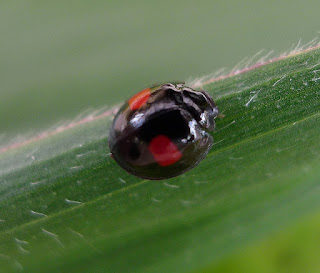
Kidney spot ladybird, as seen in OJ16 this week. It's a beetle too. CC image by GailHampshire.

Yesterday afternoon, student B and I had a go at identifying some of her beetles. It really was a triumphant success and she kindly said she felt a lot more confident about the process. I had a very pleasant afternoon and I think we both felt the geeky satisfaction of tracking a specimen through the keys and coming out at the right answer.

However, I thought I would mention here that this was not a speedy process. I've done some beetle i.d. before and so I was able to explain the terminology as it came up, pointing out the different parts of the beetle's body and showing her the classic beetle dichotomy of Crossed vs. Uncrossed Epipleura. So this speeded things up for her. But in three hours we identified three specimens. Yes this included faffing about finding microscopes, pins, printing off keys and chatting about other things. But you should still be aware that (at least to begin with) identifying your beetle (or spider for that matter) is going to take time. Do not leave things until the last minute.

Besides, we were enjoying the process, looking at the amazing detail of the beetles down the microscopes - they were surprisingly hairy, or stripey-lined, or with massive jaws, or with crazy antennae. So it was a pleasure to spend the time looking at them. Please do come and use the microscopes to examine your species, and I am only too happy to go through the identification with you. It's really useful to have two pairs of eyes to judge some of the characteristics.

We started off each time with Unwin's guide to families:


B's first specimen was huge, so much so that we initially tried to convince ourselves that the key was taking us towards the elbow-antennaed Lucanidae (stag beetles). But reason and logic prevailed. The short elytra (wing covers) led us to the Silphidae (burying beetles).

The extremely philanthropic Mike Hackston has an illustrated key to the Silphidae. And once we had got down to the right genus, his key for Nicrophorus led us to the answer: Nicrophorus humator. Fair enough, with a common species like this one, you might have been able to pick it out of the photos in a general insect guide. But you wouldn't have gleaned useful beetle-observing skills along the way and you might not have looked closely enough at the details that distinguish it from similar species.

CC image by Laisverobotams.
You'll see this species (the Black Sexton Beetle) has short elytra that don't cover the tip of its abdomen, and they look as though they've been cut off, straight across. It's got rather distinctive clubbed antennae too, and they're orange in contrast to the rest of its black body. We were rather taken by the furriness of the beetle's underside. This wasn't mentioned in the keys but we were wondering if it had something to do with the creature's lifestyle. This isn't a sweet little beetle with genteel habits. It's called a 'sexton' beetle because these seek out dead animals and bury them, laying eggs on the corpse. Some species eat fly larvae - and B found this example in a fly trap.

Our next specimen also had short elytra, showing even more abdomen. But its antennae were quite different. We used Unwin's key to put it in the Staphilinidae family - this contains about a quarter of British beetles! but luckily this species is very distinctive and we felt justified deferring to this excellent Watford Coleoptera Group page confirming its size makes it impossible to be anything other than the Devil's Coach Horse (Ocypus olens). It does seem beetles get all the best names.

The Devil's Horse Coach gets uppity. CC image by Galway Girl.

Finally we chose another black beetle from B's collection. It had long thready antennae, elytra that covered its whole abdomen, 'trochanters' underneath, and five tarsi on its front, middle and back legs. This made it a ground beetle - within the family Carabidae. Once again the keys generously provided by Mike Hackston were invaluable.  By steadily working through questions about the shape of its various parts, counting stripes and squinting for the existence of tiny hairs, we were at last able to confidently name it Pterostichus niger.

CC image by AfroBrazilian.
To the untrained eye little black ground beetles are pretty indistinguishable from each other. There simply isn't enough detail in a general insect spotting guide to be sure you've matched a species correctly - with beetles you have to be brave and attack the keys. But (as we did) you might find you enjoy it. You might get a little buzz out of solving the puzzle. And each time you do it, you'll get more familiar with the features you'll be looking for.

Naturally we recorded all we were looking at as we went along, drawing little sketches and writing down the reference numbers of the keys. Not only will this get you some marks for your notebook, it'll be a good reminder of all your previous beetles' features when you come to your next specimen.

A little note: you're welcome to come in whenever the university's open and sit in our lab. But just to say, I'm away on an exotic field trip for two weeks and will be back after Easter. I know. It's a hard job. And then you have three weeks to finish your collections. Let me know if you'd like my assistance and when.

Wednesday, 9 March 2016

More snail musings

It seems that snails are my latest Thing. I hope you feel enamoured with your own choice of flora or fauna. I do hope you've found something that sparks your interest.

I've been scrabbling about in the flowerbeds again and I'm pretty confident that I've found Trochulus striolatus, the Strawberry snail.

Photo from AnimalBase, taken by Welter Schultes.
The shells are hairy when young... did you know that snail shells could be hairy? This paper suggests it's an adaptation that helps the animals cling to food plants in wet conditions when they could otherwise fall off (which would require a tiring climb back up again, that a small and hungry snail could do without). Who knows.

Also I think I have a Oxychilus draparnaudi or Draparnaud's glass snail. You can see how the last whorl gets bigger much more quickly than that of the strawberry snail. Monsieur Draparnaud was the snail man in France in the late 18th century.

also taken by Welter Schultes.
There are several more I found, but I won't go on. Suffice to say I still think it's a good choice for a collection. Though this evening when I went through the specimens one of them was really stinky.  I poured boiling water over them but it just made a sort of stinky broth. I don't remember Mr Adams mentioning stinky snails, it did put me off a bit.

Perhaps this points at the need to use fresh (alive) snails and kill them. This seems a bit mean when there are lots of empty shells around. All the shells I've collected so far have been empty, and I know it's possible to identify lots of species from these. But some identifications rely on the colour of the snail's body, or the glossiness that only a fresh shell has. Besides, at the moment it's rather early in the season to see any live snails at all. So I'm going to keep going as I am, and then at least I'll have some tentatively named empty specimens to compare with live ones later on.

I was watching Ray Mears this evening and he was talking about how marine molluscs were a popular snack for people in this country thousands of years ago. He sat in a Scottish rock shelter looking out at the rain, in a spot where Mesolithic hunter-gatherers had sat and chewed on their shellfish - a huge midden of shells had accumulated in front of it. The woman who had excavated the site showed him some of the limpets she'd unearthed - they were 9000 years old but didn't look particularly worn. It made me reflect that where you find a shell isn't necessarily an indication of where the species lives today. Found empty shells are ok as a way to practise your identification skills but they're not really a current biological record. Perhaps this distinction should be noted on a specimen's label.

A shell midden being eroded by the River Ythan near Aberdeen. Photo by Martyn Gorman.
On the other hand, environmental archaeologists (specifically, palaeomalacologists) are pleased to find ancient shells, because it helps them infer what an environment was like in the past. Archaeological reports often have a section on snails as the species present will suggest whether a location was wood or meadow, damp or dry, and perhaps so shed light on the lifestyle of the local people.